Prefer to listen?
This website can read aloud to visitors.

This website can read aloud to visitors.
This section is part of the Energy Limiting Conditions Toolkit for nurses and Allied Health Professionals. Click here to access the starting page of the Toolkit.
Section 2 – Understanding Energy Limiting Conditions
Section 3 – Barriers to care: causes, experiences and impacts
Section 4 – Case study: lived experience of care with an ELC
Section 5 – What good care looks like: a guide for health and care practitioners
Section 6 – Making services more accessible
Section 7 – Research, policy and resources
Section 8 – About the toolkit
This section draws on findings from the research underpinning this toolkit to explore the barriers people with ELCs experience in accessing and receiving care, alongside the challenges faced by those providing it. It explores issues such as disbelief, language, mental health impacts, and wider structural and systemic factors. It also considers the role of inequality and intersectional discrimination, and the implications for trauma-informed care. For more detail on how this work was developed, see Section 8.
3.1 Disbelief, delayed diagnosis and misdiagnosis
Disbelief: Some ELC are poorly understood, and have no clear treatment path (e.g. ME/CFS, fibromyalgia, Long Covid). For other ELC, whilst the condition might be better understood, the energy impairment experienced and possible treatments for that symptom are poorly understood. Many people with ELC report experiences of disbelief, delayed diagnosis and misdiagnosis.
75% of our participants said they often or very often felt that they were not listened to by health professionals. Many ELC are more common in women, and patriarchal attitudes that have influenced the development of Western medicine persist, meaning participants reported their symptoms were dismissed as psychosomatic. This is often compounded by other forms of discrimination experienced by those with ELC who encounter sexism, racism, homophobia, transphobia, ageism and/or fatphobia.
Delayed diagnosis and misdiagnosis: 31% of our participants reported waiting over 10 years for an accurate diagnosis. Whilst some conditions do not have clear diagnostic tests, even for those that do, a key barrier to a timely diagnosis is disbelief from healthcare professionals.
Misdiagnosis: As well as being disbelieved or having symptoms dismissed by healthcare professionals, many of our participants also reported having their symptoms wrongly attributed to mental health conditions. The examples shared with us show that this not only happens in situations where the cause of symptoms may be unknown, but also in cases where a very clear explanation is available following correct investigation. This situation can create unnecessary further suffering and the provision of unsuitable, in some cases harmful, treatment strategies and contributes to long delays in accurate diagnosis.
3.2 Language and its impact on care
We have very limited language to talk about experiences of fatigue. Often people with ELC find that it is assumed that they are ‘just tired’, when the experience of energy impairment is far removed from the tiredness that people without ELC may experience. The pattern of energy impairment may also fluctuate and differ. For example, some people may be able to push through but subsequently experience post-exertional symptom exacerbation, whereas others may not be able to keep going. Some may find rest and sleep recuperative, whereas others may experience insomnia and/or unrefreshing sleep. There are some common ways of talking about exhaustion in chronic illness communities (e.g. spoon theory) that aren’t used within healthcare settings. Without shared language it can be difficult for patients to adequately communicate what they are experiencing. This means believing and listening to patients is all the more important.
3.3 Mental health impacts and avoidance of care
The consequences of disbelief, delayed diagnosis and misdiagnosis impact on the mental health and wellbeing of people with ELC in multiple ways. Many participants talked about ‘medical gaslighting’ where they were left feeling traumatised, distressed and depressed, questioning their own feelings and in some cases their own ‘sanity’. Participants also talked about feeling guilty, unimportant and undeserving of care.
“Being disbelieved has caused such distress, I have questioned my sanity and constantly gaslit myself. I’ve thought I must be wrong or somehow bad.” Participant 754: age 25-34, white, bisexual, gender fluid, England.
The implications of this for many are worsened mental health:
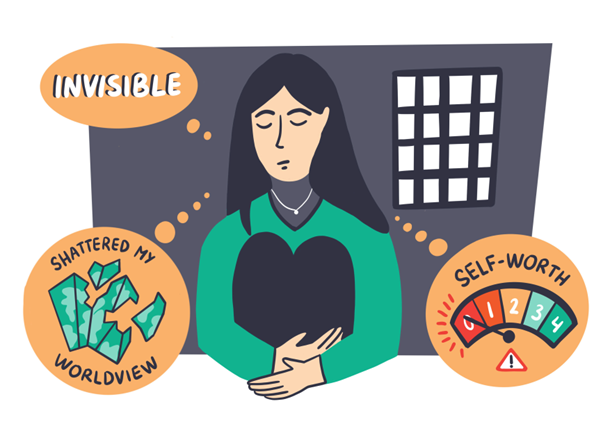
“I believe it greatly contributed to the deterioration of my mental health, it made me feel invisible, worthless, it shattered my world view; you might be treated badly by individuals in the wider world, but this was supposed to be a place of professionalism, the caring profession.” Participant 110: age 65+, white, heterosexual, woman, England.
Avoidance of care: The erosion of trust that comes as a result of repeated disbelief from healthcare professionals causes trauma and means that many begin to avoid medical encounters as much as possible. Participants know that not seeking medical care risks damaging their health, but people told us that they chose pain and discomfort over the harm they experience from medical encounters when seeking help.
“I am deeply traumatised long term from protracted mistreatments, abuse and interrogations by health and care providers. I suffer very poor physical and mental health as a result. I am no longer able to access any care support as the trauma has left me so disturbed that I can no longer undergo assessments to access any support.” Participant 844: age 55-64, white, woman, England.
3.4 Wider impacts on access and support
People with ELC also reported challenges in being believed and understood in other areas of life too, with friends, family, employers, educators and officials involved in decisions about benefits misunderstanding the severity of energy impairment and that it is not just ‘feeling tired’. In many cases, disbelief from healthcare professionals acts as a barrier to accessing support in social care, work and education and makes advocacy with family and friends difficult. This leads to difficulties in accessing reasonable adjustments, benefits, informal and formal care networks and can cause people’s conditions to worsen and intensify health inequalities. Disbelief and misunderstanding across various areas of life can therefore form a ‘pathway to inequality’, intensifying forms of exclusion and worsening symptoms.

3.5 Inequality, intersectional discrimination and the need for trauma informed care
As well as experiencing medical sexism, many participants’ experiences were also affected by intersectional forms of discrimination. For example, participants talked about this being affected by racism, ageism, ableism, homophobia, transphobia, classism, and fatphobia. For example, one participant talked about the use of racist terms “Begum syndrome or Bibi-itis” to dismiss the legitimacy of South Asian women (participant 65: age 35-44, British Asian, heterosexual, woman, England). Another reported that:
“As a Black [person] with possible autism getting the right healthcare has been difficult”. Participant 878: age 55-64, Black, bisexual, woman, England.
In relation to age, young participants reported having their symptoms dismissed as ‘growing pains’ and being denied access to necessary mobility aids and domiciliary services because they were considered ‘too young’. Participants of menopausal age reported diagnostic overshadowing in which all symptoms were dismissed as menopause. Older women also reported feeling ‘forgotten’ and having to fight to be believed because symptoms were dismissed due to their age.
LGBTQIA+ participants reported encountering barriers accessing appropriate care, including HRT, feeling unacknowledged and unseen in health services and even having their symptoms attributed to their sexual orientation:
“Well, as specialists said my problems – chronic pain etc – were due to lesbianism I tried to make myself straight. This didn’t work.” Participant 887: age 35-44, white, lesbian/gay woman, England.
Institutionalised weight stigma and fatphobia also impacted people’s experiences, contributing to delays in accurate diagnosis and treatment. 37% of participants said that prior to their current diagnosis their symptoms had been attributed to being overweight, obese, too fat, needing to lose weight, overeating, lack of will power, or lifestyle factors related to weight. Such encounters are not neutral, and contribute to stigma and make healthcare spaces traumatic ones, particularly when blame is attributed to the patient for their weight. This happens even in cases where weight gain is a part of the condition (e.g. lipoedema) or a side-effect of medication. This leads to healthcare avoidance:
“I never go to a [doctor] because whatever my illness or symptoms they always connect it to my weight. Tell me I’m fat and to lose weight and have no interest in my opinion or what’s actually the issue.” Participant 82: age 35-44, white, heterosexual, woman, England.
Participants also explained that being working class or unemployed also compounded the lack of legitimacy they had in healthcare settings. Inequalities in wealth also mean that for many participants seeking private health care instead of NHS services isn’t affordable.
In addition to multiple forms of discrimination compounding experiences of disbelief, many people may also have experienced forms of trauma that are compounded by experiences of being disbelieved. For example one participant explained that:
“Women of colour often also carry colonial traumas and physical traumas e.g energy impairment, and the lack of belief services and understanding in the system just perpetuates those traumas.” Participant 65: age 35-44, British Asian, heterosexual, woman, England.
For others, the disbelief and gaslighting they’ve encountered in healthcare settings acts as a form of trauma in and of itself. This trauma can be nuanced, and multi-layered:
“My disability is tied to trauma. Not only the grieving process lots people go through when they have to adjust their life to new health conditions, but also the gaslighting and negligence I have received at the hands of the NHS” Participant 432, age 35-44, white, bisexual woman, England.
Past experiences of institutionalised racism within the health and criminal justice services, along with stigma and a lack of culturally and religiously appropriate services also act as barriers to access to healthcare. People described how racism, sexism, poverty, immigration-related insecurity, religious visibility and disability bias can compound barriers, particularly in mental health care and benefits processes. For some ethnic minority communities, reluctance or fear about seeking mental health care or claiming benefits is grounded in experience: previous encounters of stereotyping or othering, concern about not being believed, fear that disclosure will be recorded and later used against them, and anxiety that assessment systems will treat them as fraudulent. In benefits contexts that feel adversarial, the burden of proof often falls on the person who is already unwell.
For healthcare to better serve people with ELC, trauma-informed approaches and intersectional awareness are vital (see Section 5 and Section 6).
3.6 Barriers to providing good care from a health care professional perspective
Healthcare professionals (HCPs) we spoke to were committed to providing the best possible care for their patients with ELC. However, they felt frustrated by barriers they encountered to supporting people with ELC (see also section 5.7). These included a lack of training on ELC, a lack of time in appointments to get to know a person’s symptoms and the challenges these posed for them, entrenched attitudes that meant some colleagues dismissed patients with ELC, and a lack of knowledge about ways to support people experiencing debilitating fatigue.
Many HCPs and patients shared similar frustrations around disconnected services and poor communication across and between services. For example, one participant said:
“They compartmentalise me. They don’t look for a link between my conditions. They also don’t consider trauma and subsequent conditions” Participant 839, age 45-54, white, heterosexual woman, England
One HCP participant explained that:
“The people that I see in clinic, quite often they’ve been through years and years and years of investigations and going around different doctors, and by the time they get to [my specialist] clinic where we are kind of taking what we do is kind of integrative approach, … they are so frustrated”. Specialist doctor.
Limited resources are another major frustration that HCPs and patients hold in common. Workload pressure and competing demands can make it hard for HCPs to give the level of attention they may wish to. HCPs also told us that the focus on things that can be objectively measured and on pharmaceutical treatments means that actually listening to and validating patients’ experiences is undervalued:
“We’re not good in the things that we can’t measure, or we don’t know how to investigate. And personally, I find it very frustrating, and I almost feel a sense of incompetency to some extent, as a healthcare professional. … But the more I practice, the more I recognize that what I can offer patients isn’t necessarily a medicine … care comes in in lots of forms, in terms of listening skills and meeting a patient where they’re at, you know, finding out what it is that’s going on for the patient at that moment in time.” (GP)
3.7 Positive experiences
Whilst many participants did tell us of negative experiences, others talked about the relief when encountering healthcare professionals who do listen, believe them, and do their best to help even if there is no easy treatment or cure. These experiences show the importance of validation of patient’s experiences, and that simple changes can make a huge difference:
“After many years of poor responses, I cried when a new GP listened and confirmed what I knew/experienced. It was validation. Prior to this, experiences [had] been very poor, leading me to become angry, defensive and to lose any faith in the service.” Participant 953, age 45-54, white, heterosexual, woman, England.
Many of the structural issues like time and resources we can’t solve, but HCPs also spoke about lacking education and knowledge about how to support people with energy impairment and those who experience intersecting forms of discrimination. We hope this toolkit and guidance might help HCPs feel they better understand how to support people with ELC with the resources available to them. HCPs who recognise many patients with ELC carry past trauma with them will be more able to provide adequate support. A trauma-informed approach is vital.
An animation summarising some of the key findings from this research can be accessed by clicking on the image below:
If the animation does now show up for you, you can view it here.