Prefer to listen?
This website can read aloud to visitors.

This website can read aloud to visitors.
This section is part of the Energy Limiting Conditions Toolkit for nurses and Allied Health Professionals. Click here to access the starting page of the Toolkit.
Section 2 – Understanding Energy Limiting Conditions
Section 3 – Barriers to care: causes, experiences and impacts
Section 4 – Case study: lived experience of care with an ELC
Section 5 – What good care looks like: a guide for health and care practitioners
Section 6 – Making services more accessible
Section 7 – Research, policy and resources
Section 8 – About the toolkit
This section focuses on practical ways of supporting people living with ELCs in everyday practice. It brings together key insights from research, lived experience and professional practice to outline what good, ELC-aware care looks like and how it can be delivered by healthcare professionals, within existing roles and settings.
The guidance is designed to be used flexibly across different professional roles and care contexts, offering suggestions for small, practical adjustments that can improve how care is delivered in practice.
It is structured around key aspects of ELC-aware care, informed by trauma-informed principles, including building trust and supportive relationships, communication, participation in care and shared decision-making. It also explores the challenges and opportunities within current systems. Each section includes a ‘what this looks like in practice’ component to support application in everyday care.
5.1 Trauma-informed principles for everyday practice
Supporting people living with ELCs benefits from a trauma-informed approach, which provides a lens for understanding how previous negative healthcare experiences and intersectional discrimination, alongside the ongoing experience of living with an ELC, can shape how people present, communicate and engage with care. For some, this may include hesitancy, difficulty communicating, fluctuating engagement, or avoiding services altogether. These responses are often shaped by experience rather than unwillingness, and may reflect attempts to manage uncertainty, protect limited energy, or avoid further harm. A trauma informed approach recognises that avoidance can be protective, that inconsistency may reflect fluctuating symptoms rather than unreliability.
Trauma-informed care also offers a set of practical principles, such as allowing patients to have a certain degree of control, building trust, safety and relationships, that strengthen the provision of high-quality care for all people living with ELCs. These principles can be put into practice by offering clear explanations of clinical reasoning and treating adjustment requests as legitimate needs. Trust is built through respectful listening, genuine choice, appropriate adjustments, transparent communication, and consistent, non-judgemental interactions, helping to reduce fear and stress responses, alongside wider efforts to change narrative around stigmatised illnesses through education and shifts in language and attitude.
There are 6 principles of trauma-informed practice:
These approaches are reflected in recommendations emerging from our research and are consistent with established professional standards, as well as national and regional commitments to person-centred care, non-discriminatory practice and the reduction of health inequalities. Together, this approach supports a cumulative pathway towards more equitable care.
These insights are brought together here to provide a practical guide to how healthcare professionals can better support people living with ELCs.
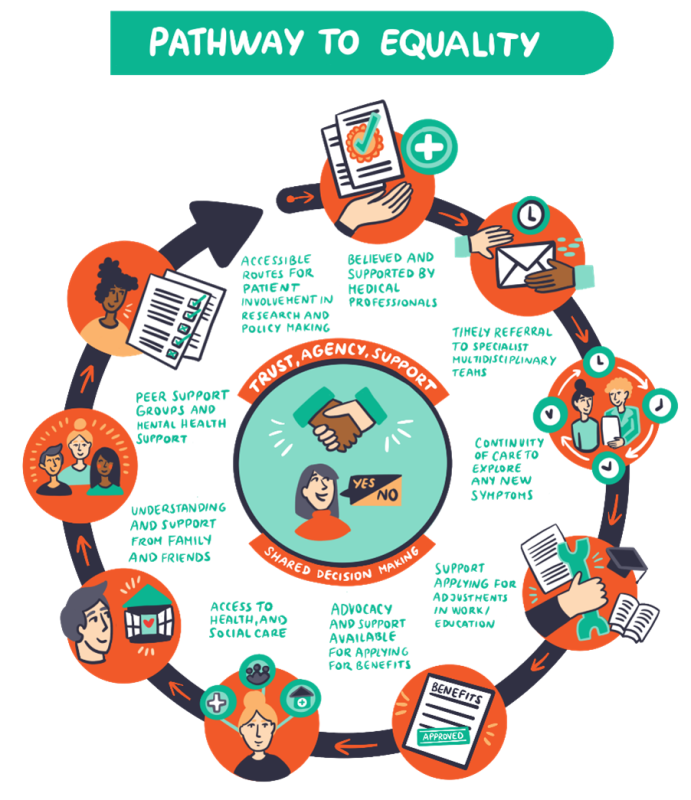
5.2 Creating supportive, trusting relationships: the foundations of better care
The quality of care for people living with ELCs is shaped by the conditions clinicians establish from the outset. Belief, validation and recognition are signalled through how clinicians listen and respond to people’s accounts and experiences. Through consistent, empathic and compassionate interactions, a trusting relationship can develop in which people feel respected and emotionally safe. This approach, in turn, supports ongoing engagement and makes better care possible.
What this looks like in practice
Create space for the person’s story
People need space to describe symptoms and impact in their own words, recognising that some symptoms and experiences are difficult to articulate. Time is often a constraint, but even small moments of open listening can significantly affect trust and engagement.
Practice attentive listening
Attentive listening involves listening for what matters to the person, including how energy limitations affect everyday personal and professional lives and relationships, and demonstrating presence through body language, eye contact and other non-verbal cues.
Start from belief
Belief and recognition are signalled by acknowledging the person’s experience as real and meaningful, particularly when symptoms are fluctuating, invisible or difficult to measure. Belief includes recognising that energy and symptoms may vary hour-to-hour or day-to-day.
Demonstrate empathy for lived impact
An empathic starting point recognises the impact of ELCs on daily life, function and identity. This can be supported by asking questions such as “what does a bad day look like for you?” or “what would you most like to be able to do more of?”
Prioritise emotional and relational safety
Focus on tone, responsiveness and respect to help people feel believed and safe to engage. Be alert to signs of distress, withdrawal or overwhelm, and respond in ways that build trust rather than pressure.
Acknowledge the cumulative burden of care
Recognise the effort involved in attending appointments, repeating histories and navigating multiple services. Where possible, take steps to reduce unnecessary repetition, such as offering a brief written summary the person can reuse across services (see also Section 6)
5.3 Language matters
Language plays an important role in the quality of care for people living with ELCs (see also Section 3.2). Careful, respectful language can validate lived experience and build confidence and trust, whereas minimising or dismissive phrasing, even when unintended, can quickly undermine that trust. Metaphors and analogies can also be helpful in describing symptoms and experiences.
What this looks like in practice
Support people to describe their experience
People often use metaphor or analogy to convey how symptoms affect their daily life, particularly when experiences are complex or hard to articulate e.g. ‘spoon theory’. This can offer valuable insight into what matters to them and how their condition shapes their lives, with awareness that metaphors and expressions may vary across cultures. Where helpful, invite metaphor explicitly, for example: “If you had to compare it to something, what would it be like?”
Use language that validates lived experience
Language that reflects the impact on daily life helps signal belief and respect. This includes noticing what people can manage day to day, rather than focusing only on symptoms.
Avoid minimising or dismissive phrasing
Be mindful of language that:
5.4 Adjusting care to support participation
Participation in care can be limited by practical and environmental factors. Small, achievable adjustments within everyday clinical practice can reduce barriers to care and help people with ELCs engage in ways that fit within their energy limits.
What this looks like in practice
Adjust pace and expectations to support participation
Be alert to signs that fatigue is affecting communication, concentration and stamina, and adjust pace or expectations during the appointments to support participation. Offer breaks and pacing during the appointment wherever possible.
Attend to physical safety where relevant
For some people with ELCs, particularly post-viral conditions, feeling physically safe in healthcare settings is essential for engagement. Simple measures to reduce infection risk, such as mask use, and options for remote appointments can signal belief, care and respect without the person having to ask (see also Section 6.5)
”They would wear well-fitting FFP3 masks to protect us and to protect themselves from getting post-viral illness. The clinics would be HEPA filtered” (Participant from “Another Future is Possible” workshop exploring future healthcare for ELCs).
Make practical adjustments to support participation
Where possible within your role and setting, offer practical adjustments that reduce barriers to participation, such as flexibility in how appointments are structured, pacing within interactions, or follow-up in alternative formats (see also Section 6.8). These adjustments can make the difference between someone being able to engage with care or disengaging altogether.
5.5 Making sense of engagement in ELC care
Engagement in ELC care is often shaped by past experiences of healthcare and the demands of living with an ELC. This section focuses on how healthcare professionals can approach and respond to engagement in ways that support safety, trust and continued care.
Drawing on trauma-informed practice and the social model of disability, the section shifts attention away from individual motivation or compliance and towards the ways services, environments and expectations shape people’s ability to engage. These frameworks also highlight how stigma, inequality, intersectional discrimination and past experiences of disbelief shape unequal experiences of care.
What this looks like in practice
Pause before interpreting behaviour
Be alert to previous negative healthcare experiences, including being dismissed, disbelieved or having symptoms attributed to mental health. These experiences can shape expectations of care, levels of trust, confidence in clinicians, and engagement.
Consider the role of discrimination, exclusion and intersectional experiences.
Be aware that previous experiences of discrimination, linked to age, culture, religion, race, gender, disability, body size or weight, class or LGBTQIA+ identity, can shape how people approach care. Small, intentional actions that signal belief, respect and safety can help reduce barriers to engagement.
Make space for relevant context
Create opportunities for people to share information about what affects their capacity to engage, such as fluctuating energy, caring responsibilities, access barriers or previous experiences, without requiring them to repeat or explain previous experiences unless they wish to.
Be cautious about linking behaviour to motivation.
Difficulty attending appointments, fluctuating energy, emotional responses or hesitancy often indicate a need to adjust plans, pace or expectations, not that someone is unwilling to engage.
Pause and review the plan.
What would make this appointment or care plan more doable within this person’s energy limits?
5.6 Supporting everyday activity and shared decision-making
Supporting everyday activity in ELCs involves understanding how different forms of activity, including physical, cognitive, emotional and social activity, affect symptoms, and working within people’s energy limits. This involves collaboration to decide pace, priorities and adaptations, informed by lived experience and professional guidance from across healthcare professions (see Section 7).
What this looks like in practice
Understanding how activity affects symptoms and recovery
Recognising people’s lived experience includes understanding that, for some people, exertion can make symptoms worse. Before agreeing next steps, explore how different types of activity, physical, cognitive, emotional or social, affect daily life, and how long recovery typically takes.
Supporting sustainable activity through pacing
Support people to spread activities out and avoid cycles of over-doing things on “better” days, leading to worsening symptoms and prolonged recovery. Work together to identify a level of activity that can be sustained, and explore practical adaptations and pacing strategies as appropriate
“The hub would have multidisciplinary professionals who are knowledgeable about ELC. They would know about pacing, they wouldn’t push us beyond our limits.” (Participant from “Another Future is Possible”exploring future healthcare for ELCs).
Work collaboratively to shape choices
Share options for how activity can be approached and be clear about what different approaches can and cannot offer. Recognise the person as an active partner in decisions about their care, drawing on their knowledge of their own body, limits and triggers alongside professional judgement, ensuring that decisions are not rushed and that people are supported to make informed choices.
Set and review meaningful goals together
Agree goals that reflect what matters to the person and are realistic within current energy and capacity. Review and adapt choices and goals over time in response to what is or isn’t working and changing priorities, with planned follow-up and check-ins to ensure ongoing support and continuity of care, wherever possible.
5.7 Professional challenges in ELC care
Healthcare professionals working with people living with ELCs often do so within systems that are not designed to support chronic, fluctuating or poorly understood conditions (see also section 3.6). Many of the challenges identified in our research require system-level changes, including clearer pathways, better integration of services, and more time and resources. In addition, clinicians are faced with limited intervention options and gaps in the evidence base. For example, Cognitive Behavioural Therapy (CBT) is often the only available psychological therapy, however this is not always well suited to the needs of people living with ELCs (see ME/CFS NICE Guidance). It may be helpful to discuss other approaches such as trauma-informed or somatic therapies, although these are not routinely available. As a result, healthcare professionals can often feel frustrated and uncertain as to how best to support their patients within these constraints.
When clinicians feel they must ‘have all the answers’, this can lead to reassurance or explanations that unintentionally minimise people’s experiences. Openly voicing uncertainty and constraints can help reduce this pressure. This honesty can help to support more honest, trusting relationships with patients and helps sustain reflective, compassionate practice.
What this looks like in practice
Acknowledge uncertainty and limits without undermining belief
Diagnostic uncertainty and limits in available interventions can be acknowledged openly without undermining belief. Clear, honest communication helps maintain trust when care pathways or evidence are limited.
Support ongoing care through realistic expectations
Supporting people to navigate services, set achievable and meaningful goals, and hold realistic expectations helps establish a relational foundation for ongoing care and sustained engagement.
Acknowledge the role of peer support
Peer support can be an important source of validation and practical insight for some people living with ELCs. Acknowledging their value can help reduce isolation and sustain engagement with care, whilst recognising that not all groups or advice will be appropriate or evidence-based.
Draw on wider clinical and professional expertise
Where appropriate, draw on expertise and guidance from other healthcare professions and specialist services (see Section 7). Making use of shared knowledge, established guidance and emerging evidence can help strengthen care planning and ongoing engagement.
Signpost to wider practical and social support
Practical pressures such as work, finances, housing or caring responsibilities can shape how people manage their health and engage with care. Acknowledging these pressures and signposting to trusted sources of practical advice or support can be helpful, without clinicians needing to take on advisory roles themselves (see section 7.5).
“I imagine many things which are health and social care related, because the two are impossible to separate for me. So much of my health is determined by my lack of access to the basic things I need to live. Like a stable income, an accessible home, mobility aids” (Participant from “Another Future is Possible”exploring future healthcare for ELCs).
Recognise and manage professional frustration
Feelings of frustration, weariness or defeat are understandable when clinicians are working in under-resourced systems with limited referral pathways and limited research evidence to guide care. Recognising these responses can help prevent burnout and maintain compassionate practice. Opportunities to share experiences with colleagues, reflect on uncertainty and think collectively about what is possible can help reduce isolation and support professional confidence.
You can make a difference
Despite systemic constraints, healthcare practitioners can meaningfully improve people’s experience of care by consistently applying the principles outlined here and acting as an advocate for people with ELCs within your organisation.
5.8 Outcomes: what good care makes possible
Together, these approaches can improve how care is delivered and what becomes possible for people living with ELCs over time. In this way, high-quality healthcare can improve quality of life not only by effectively addressing aspects of the underlying condition, but by improving people’s experience of accessing care. Feeling listened to and believed supports individual wellbeing, capacity and resilience, creating the conditions for care to be most effective.
What this looks like in practice
Enable individual agency and confidence
Good care supports people to manage uncertainty, make informed choices, and engage with services in ways that fit their capacity and priorities.
Reinforce validation over time
Consistent validation helps people trust their own experience and reduces the sense that they need to repeatedly explain or justify their symptoms.
Support people to develop language and confidence
Helping people find words for their needs, limits and priorities to enable clearer communication, shared decision-making and self-advocacy across services.
Recognise meaningful outcomes in ELC care
Positive outcomes may include:
5.9. The distinctive contribution of nurses and AHPs in ELC care
Nurses and allied health professionals (AHPs) play a particularly important role in supporting people living with energy-limiting conditions. Their expertise in managing uncertainty, working holistically, and building relationships to support quality of life across acute, community and specialist settings is ideally placed to meet the needs of people living with ELCs.
Family members and informal carers often play a central role in supporting people living with energy-limiting conditions too, particularly in managing day-to-day activities, pacing, appointments and recovery. Their involvement can be an important part of how care is planned and experienced
What this looks like in practice
Nurses and AHPs are often well placed to:
Notwithstanding the wider system transformation needed, healthcare professionals can play an important role in shaping more responsive, equitable care within their existing roles and settings through small, practical changes in how care is delivered. The following section builds on this by focusing on how services and systems can better support accessible care.