Prefer to listen?
This website can read aloud to visitors.

This website can read aloud to visitors.
This section is part of the Energy Limiting Conditions Toolkit for nurses and Allied Health Professionals. Click here to access the starting page of the Toolkit.
Section 2 – Understanding Energy Limiting Conditions
Section 3 – Barriers to care: causes, experiences and impacts
Section 4 – Case study: lived experience of care with an ELC
Section 5 – What good care looks like: a guide for health and care practitioners
Section 6 – Making services more accessible
Section 7 – Research, policy and resources
Section 8 – About the toolkit
This section draws on insights from conversations with those working within services and people with lived experience of ELCs, and sets out practical, low- to no-cost actions to improve appointment booking, communication, and waiting room environments. It is intended to support clinicians, administrative and reception staff, service managers and/or Trust leaders across all stages of care from first point of contact onwards.
For people with ELCs, access to healthcare is not just about the availability of appointments, it includes whether systems and processes protect limited energy, reduce avoidable strain, and treat people with dignity. Trauma informed care is therefore also an access requirement. It involves creating environments and processes that feel safe, reduce fear and stress, and offer clarity and predictability wherever possible.
Past experiences, including not being believed or understood, as well as stigma and shame, shape how safe people feel in seeking care and how they approach services. For some, particularly those who have experienced discrimination linked to race, gender, disability, poverty or other aspects of identity, this can include concern about how they will be perceived, whether they will be believed, and how information about them may be recorded or used. This can affect how and when people access support, including delaying, avoiding, or limiting contact where processes or interactions feel uncertain, inaccessible, or unsafe.
Barriers to accessing healthcare are not minor inconveniences, they are predictable points where systems can unintentionally discriminate and disable through rigid processes, sensory overload, uncertainty, and a lack of meaningful and applied reasonable adjustments. A trauma informed approach recognises these patterns and works to reduce them through transparent communication, adjustments, and processes that support trust rather than reinforce fear or burden.
Administrative and reception teams, in particular, are often central to whether the system works in practice and can act as key access points. Their role in shaping first contact, communication, and flexibility means they can either reduce or unintentionally reinforce barriers to care.
6.1 Flexible appointment times
People described how a randomly allocated appointment can be unworkable and distressing because symptoms fluctuate and energy is limited. Many can only manage certain times of day, and being required to attend outside those windows can trigger a crash lasting days. Some people will need to arrange help or care to attend, others will need to work around flare ups of conditions e.g more stiffness in the morning after unrefreshing sleep. This is counterproductive for the person and the NHS, increasing demand on services through repeat contact and deterioration.
Small changes that can help
6.2 Multiple ways to access care (phone, online, face-to-face)
A fair system keeps different routes open because needs vary between people and change over time. Some find digital systems helpful. Others find them exhausting or confusing, particularly with brain fog, pain, sensory sensitivity, or anxiety about getting something wrong and not knowing how to correct it. There is also the loss of relational support when everything is form-based. What helps is offering a clear choice of route where clinically appropriate, keeping a reliable phone option for those who cannot use digital systems easily, and simplifying online forms by using accessible language and removing unnecessary steps. Type of access can vary from time to time and person to person. For example, during a major flare up one may prefer a phone appointment or may feel it necessary to meet a HCP in person – this is a very individual need. A fair system keeps choice open.
“They would do home visits regularly (not just once then forget about you). They’d contact us by whatever method we chose and we’re capable of” (Participant from “Another Future is Possible”exploring future healthcare for ELCs).
Small changes that can help
6.3 Human, kind, non-rushed interaction
People repeatedly valued being met with patience and respect, especially at reception and during booking. When someone is fatigued or cognitively overloaded it can take longer to explain what is wrong, and that time is an access need rather than inefficiency or to be treated as an annoyance. Services often highlight the need to protect staff from abusive or aggressive behaviour. Alongside this, there is value in reinforcing a culture of mutual respect, where staff are supported to respond to distress or frustration with understanding and compassion.
Warm, consistent communication helps people to share information accurately and reduces escalation and distress. A simple script can normalise adjustments, for example: “Take your time. What would make this easier today?” It is also important to avoid punitive or sceptical tones in triage and booking so that people learn they can ask for what they need without being dismissed or delayed. People value being met with patience and respect, especially at reception.
Small changes that can help
6.4 Waiting rooms that reduce sensory load
People described waiting rooms as a place where energy is lost before the appointment starts. Noise, TV and radio, crowded seating, bright lighting, harsh acoustics and busy layouts can be overwhelming and exacerbate conditions especially where there is neurodiversity or complex trauma. The draining impact on the nervous system can be intense leading to dysregulation, distress and masking due to stigma and shame, ultimately leading to more draining, and worsening of conditions (a counterintuitive setting). People noted the contradiction of wellbeing messaging in spaces that actively undermine wellbeing.
Small changes that can help
6.5 Infection safety as an access need
People described infection risk concerns from close seating set-ups. For many, catching a virus can trigger significant deterioration, leading to months-long relapses, and may have been the initial cause of their illness which led to their energy limitation.
Small changes that can help
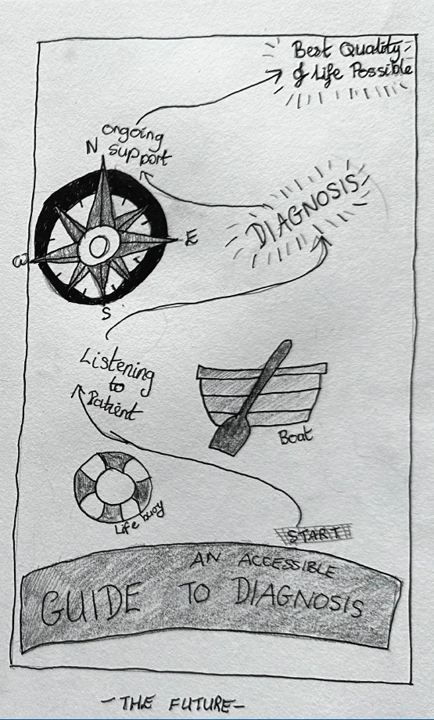
Image created by one of our research participants.
6.6 Physical access, seating, and space for mobility aids
Some people described barriers that are basic but still common: no space for mobility aids, seating that increases pain, and layouts that require others to move chairs. This is avoidable.
Small changes that can help
6.7 Clear wayfinding and practical arrival instructions
Navigating large buildings can be exhausting and stressful, particularly when symptoms include pain, breathlessness, dizziness, sensory sensitivity, or cognitive overload. Confusion and or feeling drained on arrival uses energy that people need for the appointment itself.
Small changes that can help
6.8 Communication that supports memory, brain fog, and processing
Difficulties communicating due to fatigue or cognitive symptoms, such as brain fog, can make it harder for people to describe their experiences within time-limited or structured consultations. People described leaving appointments unsure what was decided because fatigue, anxiety, and cognitive symptoms from overload affect the nervous system processing and recall. This can lead to distress, repeat calls, missed steps and reduced consent quality.
Small changes that can help
6.9 Supporting staff understanding and consistent responses
Consistent, accessible care depends on shared understanding across teams. Clinical and non-clinical staff all shape how services are experienced, particularly at points of first contact and communication.
Small changes that can help:
Key actions at a glance:
Small, simple, little-to-no cost and easy-to-implement design choices shape whether care is accessible and has a positive impact on health. When services protect energy, reduce sensory and administrative burden, and embed trauma informed, culturally aware practice that recognises the role of health inequalities, people are more able to attend, communicate, and benefit from care. This is not only compassionate; it improves efficiency, reduces repeat contact driven by unmet needs, and helps services deliver equitable healthcare in practice rather than policy alone.